| Santa Barbara , CA | 100,000 Square Feet |
The five-star resort was built on a former oil field. Extensive investigation and site studies revealed that there were high concentrations of methane gas under the site. A gas tight membrane was required to be applied beneath several of the resort buildings to protect the public from possible methane gas intrusion. Methane Specialists specified LIQUID BOOT® as the membrane system which was installed directly onto a mud slab and around the pile cap foundations. The structural slab was then poured over the membrane. The ease of application allowed the membrane to be sprayed around the penetrations and footings in a timely, cost effective fashion. A gas tight, impermeable membrane now protects the buildings and inhabitants from methane gas.
Los Angeles, CA | 80,000 Square Feet |
Upon the completion of the LIQUID BOOT® at the Cedars Sinai Central Plant in 2002, LIQUID BOOT® was again specified and is currently being installed on the Cedars Sinai North Care Tower. Over 700 penetrations were protruding the wall that needed to be air-tight. Approved Applicator Courtney Waterproofing, Inc. was selected by Swinerton Builders to install the LIQUID BOOT®. The installation began with LIQUID BOOT® UltraDrain 6200 on the lagging walls. A 6oz reinforcing fabric was then installed over the UltraDrain 6200 to provide a uniform surface to apply the LIQUID BOOT®. 100 dry mills of LIQUID BOOT® was installed over the 6oz. fabric creating a seamless membrane that sealed around all 700 penetrations. The shotcrete structural walls were then installed directly to the LIQUID BOOT® which created a fully adhered system. In the spring 2004, LIQUID BOOT® was used under the hospital foundation to combat the methane gas present in the soil.

Ontario, CA | 280,000 Square Feet |
The Colony Park High School project was built on a former a former dairy farm location. It was determined that past land use left residual Methane gas contamination in the soil. Engineering firm, GeoKinetics, Inc. along with CETCO Remediation Technologies, designed a mitigation system which consisted of LIQUID BOOT® gas vapor membrane and LIQUID BOOT® GeoVent “passive” venting system. LIQUID BOOT® Approved Applicator, Advanced Construction Technologies, spray-applied the LIQUID BOOT® onto a geotextile fabric under the slab which provided an impermeable gas vapor barrier that will prevent methane gas intrusion.

Ocean Township, NJ | 135,000 Square Feet |
The large retail store was built on a former a former landfill site. Former use as a landfill left residual methane gas contamination in the soil. The Environmental Waste Management Association, along with CETCO Remediation Technologies, designed a mitigation system which consisted of the LIQUID BOOT® gas vapor membrane system. LIQUID BOOT® Approved Applicator, Edgeboro International, spray-applied LIQUID BOOT® gas vapor membrane onto a geotextile fabric under the slab provided an impermeable gas vapor barrier that will keep methane out of the building.

Jersey City, NJ | 100,000 Square Feet |
Since summer of 2004 Edgeboro International has installed over 100,000 ft2 of the LIQUID BOOT® spray-applied gas vapor membrane system at Droyer's Point in Jersey City, NJ. The 23-acre site is being developed by K. Hovnanian Homes and will offer 30, new, three-story townhouse buildings (8-20 units each) all well-situated along the Jersey City shoreline. As a precautionary measure against residual soil vapors on site K. Hovnanian Homes in concert with Environmental Consultant, ENVIRON, designed a comprehensive Vapor Mitigation System (VMS) to be installed beneath each of the building. The VMS includes LIQUID BOOT® impermeable gas vapor membrane and an "active" venting system. The LIQUID BOOT® system was selected because it offers the advantage of being spray-applied, which in turn means a fast installation while readily achieving a vapor-tight seal around the numerous penetrations in the foundation. Once installed, the LIQUID BOOT® membrane is being smoke tested for quality control and to verify its integrity.

Allen Park, MI | 100,000 Square Feet |
An old industrial landfill owned by Ford Land Corporation is now home to the new Fairlane Green Development that is well situated between Southfield Freeway (M-39), Outer Drive, I-94 and Oakwood Boulevard in Allen Park, MI. The one million square foot development offers an outdoor shopping center that consists of a mix of retail stores and restaurants, as well as a considerable amount of green space for recreational activities, natural habitat preservation for wildlife and energy conservation. NTH Consultants designed a comprehensive Vapor Mitigation System (VMS) to be installed beneath the buildings to mitigate gas vapors present at the site. Due to offering fieldwork advantages and being a cost effective solution, portions of the phase 1 development used the LIQUID BOOT® spray-applied gas vapor membrane to seal the foundation and penetrations of the buildings. In conjunction with the membrane, the LIQUID BOOT® GeoVent System, a trenchless gas collection system, was also used to help save on construction time and money by avoiding costly trenching and significantly reducing the amount of gravel and fill needed. While the rest of the phases are undergoing redevelopment, portions of the site are now open to the public.

Irvine, CA | 40,000 Square Feet |
A two-story, cast-in-place, concrete framed office and test facility is being built for the US Department of Health and Human Services, Food and Drug Administration. Since the project was to be built on an old landfill near the wetlands adjacent to the University of California in Irvine, methane remediation and soil stabilization are major concerns. Several hundred concrete piles were driven into the ground and now hold the building firm. A methane mitigation system was designed by Kleinfelder Inc. to vent off any gas below the building. The owner chose to use methane control regulations enforced by the City of Los Angeles. 100 mil thick membrane of LIQUID BOOT® was installed onto a four ounce non-woven geotextile fabric; three inches of sand was then poured onto the geo-membrane.

Los Angeles, CA | 140,000 Square Feet |
When building within the city of Los Angeles methane zone, a project must follow guidelines set forth in the city’s methane code. The Fox Studios building is located within this zone and therefore required the use of an approved methane barrier and gas collection system. The project, which was originally budgeted around a welded sheet membrane, switched its design to LIQUID BOOT®, generating a significant cost savings as well as saving a considerable amount of time on the construction schedule. PCL Construction selected Saddleback Waterproofing Inc. to install the LIQUID BOOT® underslab and on the walls. The lagging walls incorporated 100 mils of LIQUID BOOT®, LIQUID BOOT® T-40 base fabric and LIQUID BOOT® UltraDrain 6200. The underslab utilized LIQUID BOOT® T-40 base fabric, 100 dry mils of LIQUID BOOT® and LIQUID BOOT® UltraShield P-150, which protects the membrane from damage during construction. In all, 140,000 sq. ft. of LIQUID BOOT® was installed under the slab and on the walls, protecting the Fox Studios building from methane intrusion.

Oregon City, OR | 150,000 Square Feet |
GeoSyntec were the environmental engineers who specified 150,000 sq. ft. of LIQUID BOOT® methane protection to be installed on the Home Depot site, which was to be situated on a landfill. Vent pipes were placed to collect methane gas from beneath the structure, which vent the gas to the roof for release. This prevents gas from concentrating under the membrane. The LIQUID BOOT® membrane acts as a barrier between the soil and the structure and will prevent methane gas from entering the structure.

Los Angeles, CA | 400,000 Square Feet |
LA LIVE Development, located in the city of Los Angeles Methane Zone, required extensive methane mitigation. Terra Petra, Inc., who specializes in designing methane systems, was hired by Anschutz Entertainment Group to design the methane mitigation system assembly. Terra Petra, Inc. chose to design and specify LIQUID BOOT® methane system because of it's cost effective installation and its long success history throughout Southern California. The General Contractor, Clark Construction, hired LIQUID BOOT® Approved Applicator, Gergen Construction, to install nearly 400,000 square feet of the LIQUID BOOT® system under the entire Nokia Theater and parking structure, and well as installing the LIQUID BOOT® on the lagging walls. The project was compled in the fall of 2008 and is home to thousands of visitors daily.

Los Angeles, CA | 400,000 Square Feet |
Only after excavation was started did the City realize that pure Methane gas was under the existing library. Working with Methane Specialists and CETCO Remediation Technologies, the City specified the LIQUID BOOT® membrane system that is gas tight. The City of Los Angeles, Methane Specialists, Saddleback Roofing, and CETCO Remediation Technologies. LIQUID BOOT® was spray applied under the below grade slab and walls of both the new portion of the library as well as the existing portion. All together over 400,000 square feet of LIQUID BOOT® was applied to protect all below grade walls and floors. The use of LIQUID BOOT® saved the City over $200,000 compared to the competitive system and has performed flawlessly since its installation nearly 15 years ago.

Ithaca, NY | 325,000 Square Feet |
The Lowe’s Home Improvement Center was part of a large scale landfill redevelopment in Ithaca, New York that also featured a Wal-Mart and Bed, Bath and Beyond. LIQUID BOOT was used under all three buildings as part of a methane mitigation plan to prevent against methane gas migration into the buildings. LIQUID BOOT approved applicators, Debrino Caulking, sprayed over 325,000 ft2 of membrane on the site.

Accokeek, MD | 60,000 Square Feet |
LIQUID BOOT®, a spray-applied membrane, is an impermeable gas vapor barrier that prevents methane and other gases from migrating into houses. Engineers and developers trust LIQUID BOOT® because it offers an impermeable barrier that will seal directly onto penetrations in the floor slab. LIQUID BOOT® was recently used at Manning Village by Ryan Homes, a multi-phase, single-family home development project located over a 61 acre parcel of land southeast of Washington D.C. Prior to construction of the homes, small amounts of methane were detected. The methane found in the subsurface was generated by the decomposition of organic matter present in the fill material. To alleviate any concerns due to methane gas, Ryan Homes, in connection with an environmental consulting firm, Matson & Associates, designed a state-of-the-art methane mitigation system as a safety precaution. This system included an impermeable, spray-applied, methane gas membrane, LIQUID BOOT®, and an active gas collection and venting system, which was applied by LIQUID BOOT® approved applicator, Barrett and Sons.

Milwaukee, WI | 7,500 Square Feet |
In February 2004, a groundbreaking ceremony was held to mark beginning of construction for the Milwaukee High Speed Express Ferry Terminal. The ferry, which is now operational, offers service between Milwaukee and Muskegon, MI and is the first of it’s kind in the U.S. The Milwaukee Port Authority selected a site located at the south end of the Hoan Bridge adjacent to the local Coast Guard facility. Once environmental assessment was com-pleted, it became apparent that the site had some methane present in the soil. Engineers attributed the source of the methane as dredged harbor sediments that had been used as fill in the past at the site. Once the methane issue was identified, engineers moved to design a mitigation system that would prevent any potential for methane intrusion into the buildings. The membrane needed to be fully sealed to all penetrations and building footings, so the engineer chose the spray-applied LIQUID BOOT® membrane. LIQUID BOOT® GeoVent was also used throughout the foundation to vent off the methane gas.

Newport Beach, CA | 100,00 Square Feet |
The Challenge was to prevent Methane gas from seeping into new apartments being built near a closed landfill. The Team consisted of The Irvine Company, Sares/Regis Builders, Methane Specialists, Gergen Construction (Approved Applicator) and LBI Technologies, Inc. The Solution was found when Methane Specialists designed a gas vapor membrane system, using LIQUID BOOT® that was installed over the subgrade and under the concrete slab. With the LIQUID BOOT® membrane installed, methane gas is prevented from entering the apartments and is vented into the atmosphere. The LIQUID BOOT® membrane was installed ahead of the construction schedule and has proven to be a flawless system since installation.

San Francisco, CA | 100,00 Square Feet |
New commercial buildings were constructed on a shoreline landfill site located between Highway 101 and the San Francisco Bay. The area is underlain by 75 to 100 feet of fill, refuse and weak, compressible marine clay. Due to potential settlement of the site, the buildings had to be supported on piles. A gas tight membrane was needed to prevent the possibility of gas vapors from intruding into the buildings. Treadwell & Rollo specified LIQUID BOOT® as the gas vapor membrane. A seamless, cold, fluid-applied membrane, LIQUID BOOT® was installed directly onto the structural slab. A topping slab was then poured over the membrane. The gas tight, monolithic membrane now protects the buildings against gas vapor intrusion. LIQUID BOOT® was installed at a much lower cost compared to traditional sheet membranes and has been selected as the gas vapor membrane for all additional buildings at Sierra Point.
San Diego, CA | 100,00 Square Feet |
San Diego North County Transit District had entered into escrow to sell a part of its property to a housing developer. Prior to the close of escrow, the developer discovered low levels of hydrocarbons on the site. It was determined that the source of the contamination was an oil and gas storage facility adjacent to the property. Kleinfelder worked closely with the San Diego County Health Department, North County Transit District and developer to develop an extensive mitigation plan. Part of the plan called for a LIQUID BOOT® membrane to be installed under the slab and footings of the new homes to protect the homeowners from possible future migration of hydrocarbons from the adjacent site. The North County Transit District was able to sell the site to the developer who had subsequently constructed an extremely successful tract of single-family homes.

Fresno, CA | 10,000 Square Feet |
The Mehmet Noyan Company is the master developer of 75 acres of former Calcot Ltd. property in Fresno, CA. Half of the property is impacted by shallow landfills that cover roughly half of the site. Fresno County Environmental Health and the Integrated Waste Management Board of California required the impacted area be developed in accordance to the California Code of Regulation, Title 27, Article 6, which requires the use of an impermeable barrier system and a gas collection system. In accordance to code, Technicon Engineering Services, Inc., has specified LIQUID BOOT® along with the LIQUID BOOT® GeoVent system, for buildings on and with in 300 feet of the landfills.
Los Angeles, CA | 140,000 Square Feet |
The product used to protect against methane intrusion has been and continues to be LIQUID BOOT®. LIQUID BOOT® has been successfully installed on over 1.5 million sq. ft. under the below grade foundations. Carabela, by Standard Pacific Homes, has two levels of subterranean parking. The membrane was designed by Carlin Environmental, who specified the LIQUID BOOT® system to be used under the slab and on the walls for methane protection. Approved Applicator, Gergen Construction, installed the LIQUID BOOT® system. The applicator sprayed 100,000 sq. ft. of LIQUID BOOT® onto a 4 oz. geotextile fabric. The membrane creates a complete seal, blocking off methane gas from entering though the slab. The methane barrier was then wrapped up the masonry walls where LIQUID BOOT® UltraDrain 6200 was then placed to provide additional protection. In total, 130,000 sq. ft. was installed, creating a seamless, vapor-tight system. The Carabela project is one of 21 other subterranean structures at Playa Vista successfully completed with LIQUID BOOT®.

Los Angeles, CA | 100,000 Square Feet |
Over 1 million square feet of LIQUID BOOT® has been utilized on the largest development in Southern California called Playa Vista. Spanning over 1,000 acres, Playa Vista will furnish housing, retail shops, and office space to the community. With 17 substructures in place, LIQUID BOOT® has been the product of choice to handle the below grade gas barrier. In addition, LIQUID BOOT® has been used as the plaza deck over the below grade garages. Because of the quality and efficiency of LIQUID BOOT®, the general contractor was saved time and money while getting a superior product that will keep the gas tight. The installation of the LIQUID BOOT® was completed by Approved Applicator Gergen Construction. The LIQUID BOOT® was installed directly onto the structural slab creating a seamless and fully adhered system. To complete the system, a 2” topping slab was poured as the finished surface.
Los Angeles, CA | 100,000 Square Feet |
Conveniently located between the bluffs of Westchester and Marina del Rey in the city of Los Angeles, Playa Vista is under construction on a former industrial and agricultural site neighboring the Ballona Wetlands. Playa Vista will encompass a mix of affordable and luxury residential housing, plus office and commercial space. Parks and recreational amenities will also be featured in this full-service community. An integral component to the buildings of Playa Vista is a proven and effective methane gas barrier system. The LIQUID BOOT® membrane along with a gas collection system protects the buildings against gas vapor intrusion. LIQUID BOOT® gas vapor membrane is being used extensively at Playa Vista. LIQUID BOOT® is being used in several different applications such as spread footings, piles and mat slab. Installations around penetrations and footings are done in a timely and cost effective fashion.

Salem, MA | 33,000 Square Feet |
Over 33,000 square feet of LIQUID BOOT® and 3,000 lineal feet of LIQUID BOOT® GeoVent was installed to prevent petroleum hydrocarbon gas intrusion/migration into the new Public Storage building.ENSR International's environmental assessment of the property determined that the top 6 to 16 feet of soil at the site contained oil and/or hazardous materials (OHM) including metals (primarily arsenic, chromium and lead), and petroleum hydrocarbons. OHM in groundwater include petroleum related VOCs, arsenic, chromium and lead. The OHM detected at the property are believed to be associated with the historic property use as a leather tanning operation from the 1800s until approximately 1957 as well as from urban fill materials. Petroleum was present in the vicinity of a former underground storage tank as well as other site areas. ENSR International subsequently was responsible for the design and implementation of the vapor intrusion gas mitigation system for the new building. Their design was based on the combination of a spray-applied, impermeable gas vapor membrane, LIQUID BOOT®, and a trenchless gas collection system, LIQUID BOOT® GeoVent. The benefit and versatility of the LIQUID BOOT® spray-application became immediately evident when LIQUID BOOT® applicators, Terrafix Environmental, encountered earthen-poured grade beams that were extremely rough at the surface. They were able to achieve a gas-tight seal with some field expertise by "flooding" the edge of the grade-beam with LIQUID BOOT® and then attaching the LIQUID BOOT® membrane to the flooded edge of the grade beam. Such a solution would not have been an option with a sheet membrane the use of LIQUID BOOT® resulted in a gas-tight membrane system that could be installed significantly faster than any other system, given the challenging site conditions.

Miami, FL | 45,000 Square Feet |
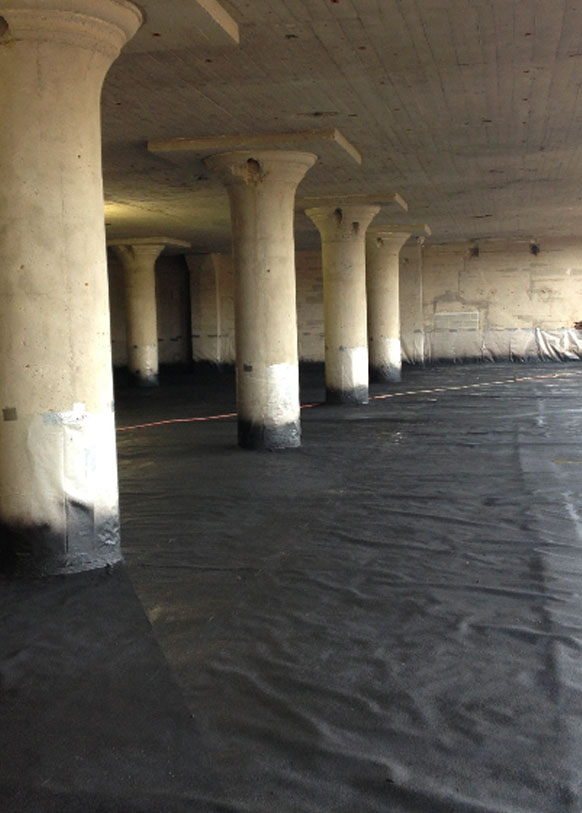
In 2003, developer Taubco broke ground on a retail center in North Miami Beach. The site, a former landfill, had high levels of methane and ammonia gasses present in the soil. GeoSyntec Consultants designed the gas vapor barrier system around LIQUID BOOT®, and in conjunction with a passive gas venting system to prevent gas vapor migration into the building. With approval from the Department of Environmental Resources Management (DERM) in Miami-Dade County the LIQUID BOOT® installation was ready to begin in Spring 2004. Approved LIQUID BOOT® applicator, Terrafix Environmental, sprayed 45,000 square feet of LIQUID BOOT® beneath the Publix Supermarket. The membrane was applied to a geotextile fabric laid on the sand and sealed directly to the 1400 penetrations and pile caps under the foundation slab. After smoke testing procedures were performed by the applicator and upon inspection by GeoSyntec, the integrity of the membrane and all attachments was ensured and the LIQUID BOOT® was then covered by a protective geotextile fabric.

Queens, NY | 85,000 Square Feet |
College Point, Queens, New York is the site of the Waste Transfer Facility for the New York City Department of Sanitation. As the two acre site is situated on a former landfill, LIQUID BOOT® was installed in conjunction with a venting system to protect the building from the threat of methane gas intrusion. Located on an old landfill and in close proximity to the East River, proper site preparation included the installation of over 600 piles. The many pile caps, grade beams, piping penetrations and other protrusions on site meant that the underslab methane barrier installation would be a complicated and difficult task. The use of LIQUID BOOT®, a spray-applied gas vapor and waterproofing membrane, offered the advantage of "spray painting vs. wall papering" in comparison to a sheet membrane. In situations such as this with a busy underslab surface, LIQUID BOOT® typically can be installed much more efficiently than sheet systems. A second distinct advantage is that once applied, the LIQUID BOOT® system not only creates a gas tight membrane, but one that is fully bonded to the concrete floor slab above it. This is extremely useful in landfill redevelopment situations where soil settlement can cause tearing in a non-adhered system. Structural Preservation Systems out of Hawthorn, New Jersey installed over 85,000 square feet of LIQUID BOOT® on this project, which is still under construction.

Queens, NY | 25,000 Square Feet |
The Queens Vocational School project was an addition to the exiting structure. Residual VOCs in the soil warranted the use of a gas vapor membrane system. LIQUID BOOT® was the specified gas vapor barrier for this project due to its cost effectiveness and ease of installation. Langan Engineering, along with CETCO Remediation Technologies, designed a mitigation system which consisted of the LIQUID BOOT® gas vapor membrane system. LIQUID BOOT® Approved Applicator, EAI Inc. out of Jersey City, NJ, spray-applied LIQUID BOOT® gas vapor membrane onto a geotextile fabric under the slab provided an impermeable gas vapor barrier that will keep methane out of the building.

New York, NY | 50,000 Square Feet |
The challenge was to encapsulate a landfill, thereby preventing harmful gas vapors from intruding into the new correctional facility.” Expansive soil was also a factor in designing this complex vapor barrier system. SCS Engineers, Gatti & Lopez, Laquilla General Contractors, LBI Technologies, Inc. was the team involved. SCS Engineers and LBI Technologies devised a system where LIQUID BOOT® would be sprayed under the foundation slab and on the structural walls of this new complex. Gatti & Lopez were the Approved Applicators who installed more than 50,000 square feet of material. A venting system was incorporated in the slab to extract all the contaminants that would be held under the LIQUID BOOT® membrane. LIQUID BOOT® sealed off the vapor contaminants in the soil preventing them from seeping through the concrete. Sensors were placed in the facility to gauge any hydrogen sulfide gas that might intrude the building- the sensors have never needed to react.

New York, NY | 50,000 Square Feet |
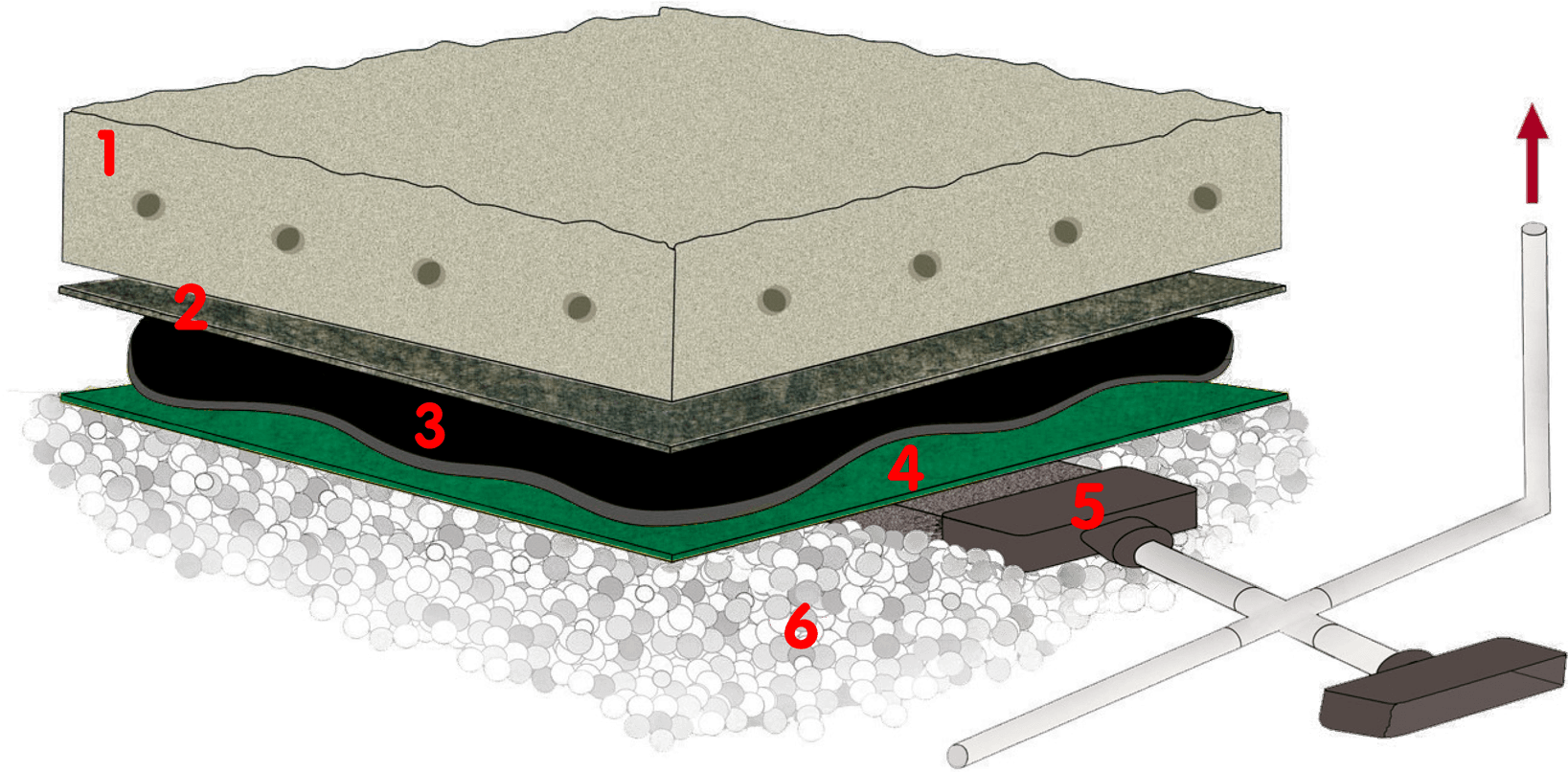
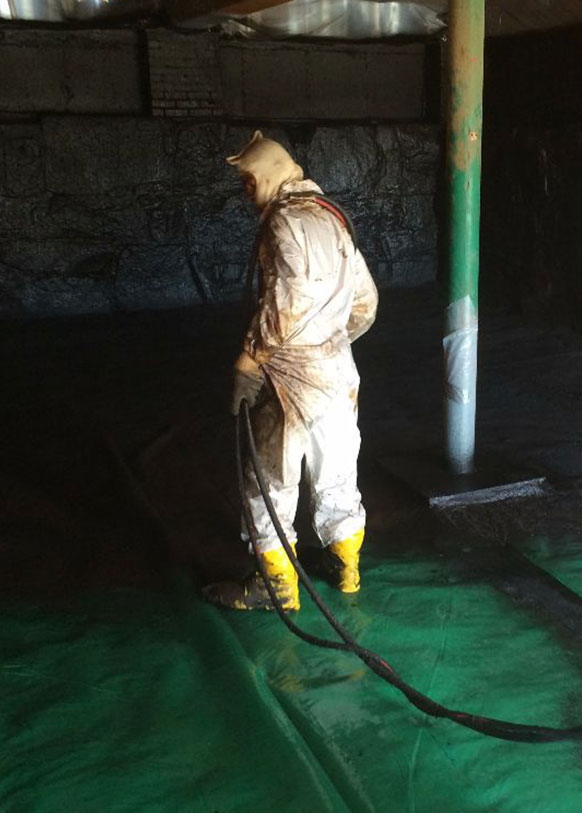
A new central storage warehouse is being constructed at the Rikers Island Correctional Facility in New York City. As the site is located on a former landfill, levels of hydrogen sulfide gas and methane gas have been detected in the soil. The LIQUID BOOT® gas vapor membrane was installed underslab in conjunction with a venting system to protect air quality and ensure safety inside the buildings. LIQUID BOOT® has been the membrane of choice on Rikers Island projects for the last decade spanning numerous projects. LIQUID BOOT® is a spray-applied, fully adhered system. As a result, a secure, gas-tight connection to walls, pile caps and other vertical surfaces can be achieved without the need for a battening system. For underslab applications such as Rikers Island Central Storage, LIQUID BOOT® is typically sprayed onto a geotextile. To properly secure the membrane to a vertical surface, an 80 mil adhesive layer of LIQUID BOOT® is first sprayed onto the vertical surface. The geotextile is then imbedded into the 80-mil adhesive layer, which is bonded to the concrete. Finally, the primary layer of LIQUID BOOT® is sprayed onto the geotextile and up the vertical surface. A gas tight "sandwich layer" of LIQUID BOOT®, geotextile and LIQUID BOOT® securely fastened to a vertical surface.
Sacramento, CA | 65,000 Square Feet |
LIQUID BOOT® has been installed on 65,000 square feet for use as a gas vapor protection system. The site is located directly adjacent to a former landfill site and is the first project of it’s kind in the city of Sacramento. Hugh Avery, of Terra-Petra, Inc., worked along side the Integrated Waste Management Board of California to develop a methane gas monitoring system. The system included LIQUID BOOT®, as well as a low profile venting system and methane sensors in the occupied space. Hugh Avery has specified LIQUID BOOT® for use as a gas vapor barrier on previous jobs, and continues to specify LIQUID BOOT® for proven performance and cost effectiveness.

Albuquerque, NM | 100,000 Square Feet |
Under New Mexico's new methane mitigation guidelines, structures within 1000 feet of a landfill require measures to prevent the lateral migration of methane gas. The new guidelines require that an engineer evaluate the site and determine if methane intrusion is a threat. Further evaluation determined the site did not require mitigation, however Target followed the trend of developers' nationwide and implemented the LIQUID BOOT® system. Paul Baginski, of Kleinfelder Engineering, designed the LIQUID BOOT® membrane system along with a low profile vapor collection system, LIQUID BOOT® GeoVent. Advanced Construction Technologies out of Irvine, CA expeditiously installed the mitigation system. A six person crew installed approx-imately 100,000 square feet of LIQUID BOOT®, the GeoVent system and a 100,000 square foot 6" gravel layer in 7 days! The speed of installation kept Conlon Construction's schedule uninterrupted. Target was able to save time and money as well as prevent future liability by implementing the LIQUID BOOT® system.

Reading, MA | 175,000 Square Feet |
In a public-private partnership between the Town of Reading, Massachusetts and Dickinson Development Corporation, Walker’s Brook is a mixed-use development built on a former landfill. Methane levels were found 50% by volume. Haley & Aldrich specified LIQUID BOOT ® along with an active gas venting system to mitigate the threat of methane vapor intrusion into the Home Depot. The design was then submitted and approved by the Massachusetts North East Regional Department of Environmental Protection. Approved LIQUID BOOT ® applicator, Terrafix Environmental, installed 175,000 square feet of LIQUID BOOT ® gas vapor barrier underslab. The foundation design was challenging with over 1,000 piles being driven for the LIQUID BOOT ® membrane to seal to. As settlement was an issue, one of the many benefits of LIQUID BOOT ® is the ability to be an adhered system. LIQUID BOOT ® was sprayed to a 6oz. typar geotextile and then covered with a 10oz. non-woven geotextile for protection. This creates a LIQUID BOOT ®-geotextile sandwich which adheres to the bottom of the concrete slab that is poured. To ensure the integrity of the membrane, Terrafix conducted smoke testing after the LIQUID BOOT ® was cured. In using LIQUID BOOT ® the owner was able to save significant time and money compared to a sheet system.

Woodbridge, NJ | 130,000 Square Feet |
At the corner of Main Street and Woodbridge Center Drive in Woodbridge, NJ is a large site adjacent to a landfill. When preliminary site investigations were conducted, a few hot spots of methane were detected that caused concern about building on the site. Wegmans was interested in building a grocery store on the site and needed a methane mitigation system that would ease concerns about housing food products on a site with methane. To properly seal off a foundation from vapor intrusion, the penetrations must be properly detailed and sealed. LIQUID BOOT® was chosen as the specified product by Vollmer Associates of Philadelphia, PA, because as a spray-applied gas vapor membrane, LIQUID BOOT® could seal penetrations on the foundation with greater efficiency than a sheet membrane. This drastically eliminates the avenues for leaks. LIQUID BOOT® membrane, paired with LIQUID BOOT® GeoVent, a trenchless gas collection system, were specified to mitigate gas vapor. Not only were they able to seal the foundation and penetrations with LIQUID BOOT®, the use of LIQUID BOOT® GeoVent saved them a considerable amount of time and money by avoiding costly trenching.

Chicago, IL | 2,400 Square Feet |
A Wendy’s franchise owner chose to build a restaurant near an adjacent shopping center in Chicago’s south side. During initial site investigations, Giles Engineering (Waukesha, WI) was hired to perform some site analysis. Through their research, Giles learned that the site had been a former service station, and discovered that some residual petroleum contamination remained in the soil below the proposed restaurant footprint. When excavating the waste was determined to be cost-prohibitive, Giles was faced with the task of eliminating all potential VOC exposure pathways. LIQUID BOOT® was selected as the product of choice to seal off the building footprint from the contaminated gasses. In order to better protect the structure, LIQUID BOOT® GeoVent was also used to provide a venting layer beneath the membrane. LIQUID BOOT® GeoVent was placed in a layer of sand to provide adequate ventilation. The LIQUID BOOT® gas vapor barrier system was then installed over the venting and sealed to all footings and all pipe penetrations. LIQUID BOOT® was chosen because of the product’s ease of installation and ability to seal directly to all required attachments.
 |